
By Chris Murray
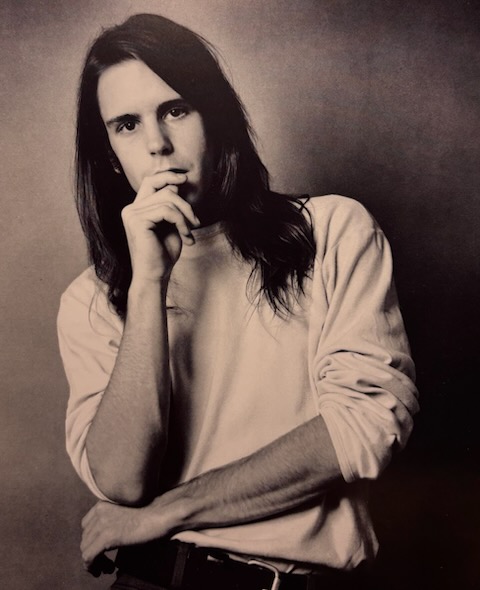
Photo by Baron Wolman.
I had the great pleasure of first exhibiting Baron Wolman‘s photographs at Govinda Gallery in 1994. Baron was the first chief photographer for Rolling Stone Magazine. I went on to exhibit Baron’s photographs internationally in museums and galleries. This portrait of the late great Bob Weir was taken in 1969. Hats off to Bob and Baron, both of them gone but not forgotten.
My friend and collaborator Wade Davis wrote the text for The Kennedy Center Honors catalogue in 2024, honoring The Grateful Dead. Wade was a dear friend of Bob Weir. Here are Wade’s words honoring The Grateful Dead, and Bob.
Wade Davis Tribute to the Grateful Dead, Kennedy Center Honours October 2, 2024
The Acid Tests set the stage- Kesey and the Pranksters, a tapestry of sound and light, the audience as one with the band, an ecstasy of movement, a partnership of equals, no leaders, no adulation, no limits; a shared quest, a “cosmic mandala,” as Jerry Garcia described it. Young people seeking something new, going further than any thought possible.
LSD was the catalyst. Nothing taught in school or distilled from scripture could match what acid delivered, a spiritual catharsis that cracked open the sky. Parents warned that if you took the drug you’d never come back the same. That, of course, was the entire point.
But for the Dead it was always about the music and they could play anything- rock and roll, blues, folk, Stax-Volt, rhythm and blues, rockabilly, jug band, country-western, gospel, calypso, western swing, New Orleans, or jazz. Their setlists drew from every genre, a repertoire that in time grew to over 500 songs. No two shows were ever the same- and they played 2,318 of them.
Their influences included Earl Scruggs, Bill Monroe, Merle Haggard, and Buck Owens, but also Miles Davis and John Coltrane, who taught them what improvisation was all about. Jazz saxophonist Branford Marsalis sat in during the spring tour of 1990 and was blown away. “I’d never seen anything like it. Most rock shows are just like versions of MTV, but not the Dead…Those guys can play music. They’re into jazz, they know Coltrane, they’re American musical icons.”
The band members were all exceptional musicians- experimental, innovative, and courageous. Phil Lesh, a prodigy entranced by classical music at the age of four, took up bass guitar on a whim and reinvented what it meant to be a player. Ron “Pigpen” McKernan, son of an R&B disk jockey, was a serious student of the blues. Bobby Weir, a four-year veteran of the scene at just 21, played rhythm guitar in his own inimitable style, seeking always the spaces between the tones, the sounds between the notes, his singing voice as fine as any in rock and roll.
Their work ethic was ferocious, their dedication to craft unreal. When Jerry Garcia first picked up the banjo, he practiced four hours a day and then went out and played for another three. Mickey Hart and Billy Kreutzmann joined forces in 1967 as the original rhythm devils; they used self-hypnosis to synchronize their beats, each drumming with one hand around the other’s back, both playing with one arm, pausing to check their pulses, locking in their heartbeats. Mickey laid down the challenge. “We’re not in the entertainment business. We’re in the transportation business. We move minds.”
And indeed, they did. No band has ever had a stronger connection to its audience. The legions of Dead Heads saw the band members as no different from themselves, save that the boys could play. “We exist by their grace,” Garcia acknowledged, explaining the band’s unprecedented decision to allow their concerts to be taped. “Once we’re done with [the music], it’s theirs.” Reciprocity forged a single community. The Dead played everywhere and often, keeping ticket prices as low as possible and gifting tickets at random. The Dead Heads in turn carried the band. As Phil Lesh put it, “When the Grateful Dead is happening, it happens to everyone, band and audience. So in a sense, we’re all playing in the band.”
They sang of emptiness and sorrow, redemption and hope. Grifters and dreamers, losers and winners, Cain, Ezekiel and Delilah. Out of the madness, war in Viet Nam, racial agonies at home, they offered a new American dream, which was in fact as old as the nation itself- the notion that all things are possible, that you can take to the open road and reinvent your past, reimagine your present, resurrect your future. Their lyrics showed what words can do, the bardic poetry of Robert Hunter, the musings of John Perry Barlow, eyes wide open to wonder, both serving a universal muse, music reaching out as the ultimate weapon of love.
Joseph Campbell, who spent much of his life seeking evidence of mythic archetypes in contemporary culture, hit pay dirt at his first Grateful Dead show. “This was a real Dionysian festival- 25,000 people tied at the heart, standing in mild rapture for five hours while these boys let loose everything on stage. This is more than music. It turns something on here, in the heart. And what it turns on is life energy.” He later described a Grateful Dead concert as a religious experience, “the antidote to the atom bomb.”
As Dead Heads have always professed, there has never been anything to compare to the Grateful Dead, very much alive, playing their hearts out, true always to a single mantra; it is not the artist that sings the song, as Bobby Weir would say, it is the spirit of the song that sings the artist. After more than sixty years, they remain the most successful band in the annals of American popular music, with a legacy that has incomparably enriched the American songbook, musical stories that will fire our hearts for generations to come.
Wade Davis is a cultural anthropologist and an award-winning writer, photographer and filmmaker. He was Explorer-in Residence for the National Geographic Society from 2000 to 2013.
 Govinda Gallery
Leave a comment